
From Chaos to Control – Transforming Log Management for a Leading Payment Solution Company
The Customer:
A leading payment solution company processing millions of daily transactions where uptime, speed, and reliability are business-critical.
The Challenge:
The existing log management system struggled with 25,000 events per second, data silos, and unreliable UDP traffic, leading to delayed incident response and risks to compliance and uptime.
The Solution:
Ashnik implemented an Elastic Stack–based architecture, introducing fault-tolerant UDP handling, Kubernetes-based scaling, optimized Elasticsearch performance, and Kibana dashboards for real-time visibility.
The Benefits:
We achieved 100% log delivery accuracy despite UDP limitations, while scaling the system to handle over 60,000 events per second. This enabled real-time insights for faster anomaly detection and resolution, along with dynamic scalability and optimized storage that deliver both resilience and cost efficiency.
Customer Overview
In the highly time-sensitive world of digital payments, uninterrupted service and real-time operational visibility are critical. A leading payment solution company processing millions of daily transactions faced increasing strain on its log management system. What was once a stable setup began to falter under rapidly growing data volumes.
At its peak, the company was handling 25,000 log events per second, and the system’s inability to cope was putting service uptime, compliance, and customer trust at risk.
The Challenge
The company’s IT team was confronted with multiple, interconnected issues:
- Scalability Limits: The existing infrastructure could not handle the surge in log volumes.
- Fragmented Data: Information scattered across disparate systems slowed down investigations.
- Delayed Response: Incident identification and resolution were increasingly inefficient.
- UDP Traffic Reliability: As logs were transmitted via UDP, ensuring complete delivery without data loss was critical but difficult.
These challenges were not just technical hurdles—they directly threatened the company’s ability to maintain reliability in an industry where even seconds of downtime are unacceptable.
Ashnik’s Role
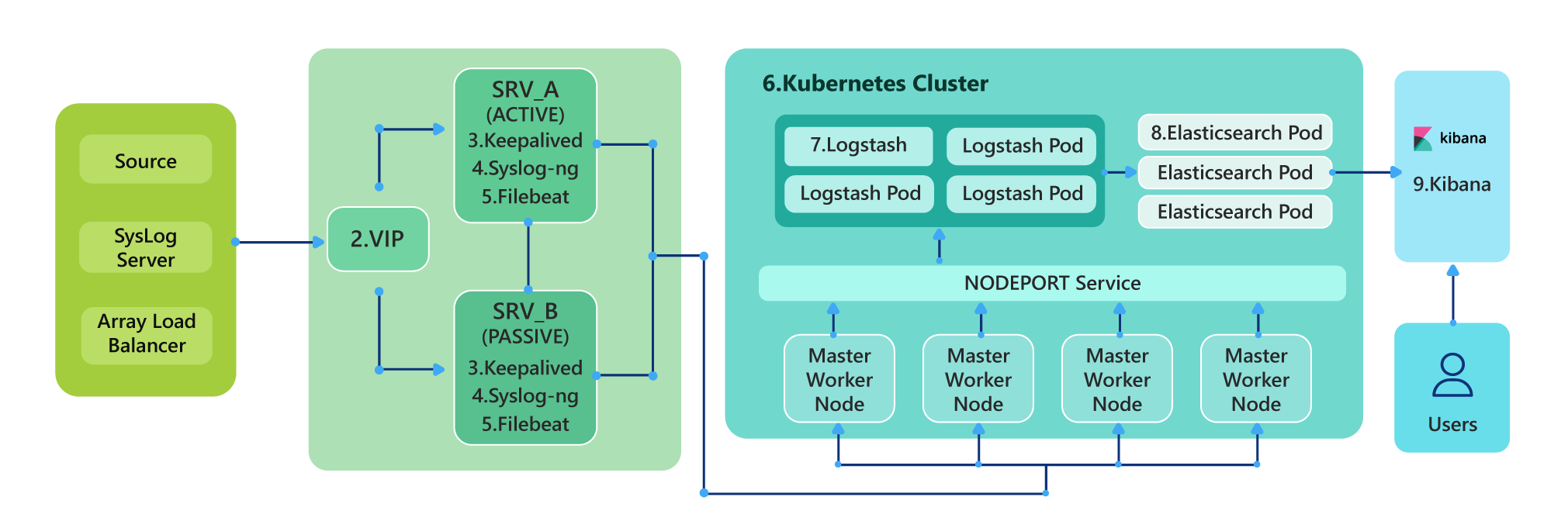
Ashnik worked closely with the client’s IT team to redesign and implement a resilient log management architecture based on the Elastic Stack. The goal was not only to restore control over the log flow but also to make the system future-ready.
Key Interventions
- Reliable UDP Log Handling
- Introduced Virtual IP (VIP) and Array Load Balancer to ensure fault tolerance.
- Deployed Syslog-ng to capture UDP logs reliably and write them to disk, guaranteeing no data loss.
- Streamlined Ingestion and Processing
- Configured Filebeat to forward captured logs into Logstash for parsing and enrichment.
- Deployed Logstash and Elasticsearch within Kubernetes, enabling automatic scaling with data load.
- Scalable, High-Performance Search
- Tuned Elasticsearch to handle up to 60,000 events per second, providing real-time indexing and search.
- Operational Visibility
- Built Kibana dashboards to transform raw logs into meaningful insights.
- Enabled teams to quickly spot anomalies, track trends, and respond proactively.
- Performance Optimization
- Identified and resolved bottlenecks during testing at 100,000 events per second.
- Recommended a shift from CEPH storage to natively attached storage, significantly improving throughput.
- Simplified Kubernetes deployment by using services instead of more complex ingress models.
Quantifiable Difference
| Metric / Area | Before Intervention | After Elastic Stack Deployment |
|---|---|---|
| Log Ingestion Reliability | UDP-based, prone to loss | 100% accuracy with Syslog-ng |
| Ingestion Throughput | Struggling at ~25,000 events/sec | Scaled up to 60,000 events/sec |
| Performance at Stress Test | Bottlenecks at 100,000 events/sec | Optimized with direct storage |
| Incident Response | Delayed due to fragmented data | Real-time insights via Kibana |
| Infrastructure Scaling | Manual and limited | Dynamic scaling with Kubernetes |
| Operational Uptime | Threatened by inefficiencies | Resilient even at peak loads |
Outcome
The redesigned system brought order to what was once a chaotic log environment. The payment solution company now operates with:
- Resilient log ingestion even over UDP.
- Real-time analytics to detect and address issues faster.
- Dynamic scalability that grows with business demand.
- Optimized infrastructure costs without compromising reliability.

Conclusion
By re-architecting the log management platform with Elastic Stack, the company moved from operational firefighting to proactive control. What was once an overwhelming flood of data is now a structured, high-performance system. This transformation has enabled the IT team to ensure uptime, compliance, and a seamless experience for customers—even under intense load.