




A trillion dollars wiped out. Two industries in fear. But some companies aren’t waiting — they’re already rewriting the rules.
On January 30, 2026, Anthropic quietly pushed eleven open-source AI plugins to GitHub. By February 3rd, markets had caught up. Not a new model. Not a research paper. Tools that could autonomously handle legal reviews, financial reconciliation, sales pipelines, and customer support — end to end, no human required.
Markets responded as if the sky had fallen. $285 billion in software value wiped in a single session. A trillion dollars gone within two weeks. IBM down 13% in one day. The Nifty IT index posted its worst month since 2008. Salesforce, TCS, Infosys, Wipro — all hit multi-year lows. Wall Street called it the SaaSpocalypse.
The panic was loud. But the more important story is quieter — how the industry is already waking up and responding. Because the companies that smelled the coffee early are not waiting to be disrupted. They are doing the disrupting.

The SaaS model was built on one elegant idea: pay per seat, per month, forever. The more users inside an enterprise, the bigger the invoice. For two decades, it was the most reliable business model in technology.
AI doesn’t kill that model overnight. But by early 2026, analysts at Jefferies and others had begun flagging what they called ‘seat compression’ — the gradual shrinking of the human headcount that occupies those seats. The logic is simple: if an AI agent handles what ten analysts used to do inside Salesforce or ServiceNow, those ten seats disappear. The platform still runs. The invoice shrinks. The growth story Wall Street once priced at 40–60x forward earnings suddenly becomes much harder to model
The numbers tell a more complicated story, though. ServiceNow’s Q4 2025 subscription revenue grew 21% year-on-year. Salesforce’s contracted future revenue stands at $72.4 billion, up 14%. These are not companies in collapse — they are companies whose growth trajectory is harder to model, and in an overvalued market, uncertainty alone triggers selling.

Not everyone accepted the premise. NVIDIA’s Jensen Huang called the market fears ‘illogical,’ and JPMorgan’s enterprise software analysts argued it was an ‘illogical leap’ to move from ‘AI can automate tasks’ to ‘enterprises will rip out Salesforce.’ Their point has merit: enterprise software replacement cycles run five to ten years, switching costs are enormous, and the same AI wave that compresses seats also creates new categories of software spend. The disruption thesis doesn’t require ignoring these facts — but it does require acknowledging them.
But here is where the response gets interesting. The smarter SaaS companies did not wait to be victims of this shift. They moved to own it.
Salesforce launched Agentforce — repositioning itself not as software that humans use, but as the orchestration platform that AI agents run on. The logic is sharp: if your data layer is the foundation every AI agent needs to operate reliably inside an enterprise, you don’t lose relevance — you become indispensable at a new layer. Over 60% of Agentforce bookings in Q4 came from existing customers. The installed base is not fleeing. It is doubling down. The revenue signal backs the narrative: Agentforce ARR reached $800 million in Q4 2025, up 169% year-on-year — a growth rate that suggests the repositioning is landing, not just being announced.
ServiceNow made a similar bet, embedding Now Assist natively into its platform and positioning its CMDB as the clean, unified data backbone that AI needs to avoid hallucinations in enterprise workflows. SAP launched Joule, its AI copilot, to turn ERP from a system of record into an active decision layer. The pattern is consistent: don’t compete with AI, become the infrastructure it can’t work without.
| Company | Initiative | The Play |
|---|---|---|
| Salesforce | Agentforce | Makes Salesforce the orchestration layer for AI agents — not just a CRM, but the platform AI runs on top of. |
| ServiceNow | Now Assist + AI Platform | Positions its CMDB as the enterprise data backbone AI needs to avoid hallucinations and failed workflows. |
| SAP | Joule AI Copilot | Embedding AI across ERP workflows — turning SAP from a system of record into an active decision layer. |
What’s notable is that these three bets are not equivalent. Salesforce’s Agentforce play is the most aggressive — it is repositioning a CRM company as a general enterprise AI infrastructure, which puts it in direct competition with the hyperscalers. ServiceNow’s CMDB-as-backbone argument is more defensible but also more narrow. SAP’s Joule is the most captive play: its value is almost entirely dependent on customers who are already locked into SAP’s ERP ecosystem. As AI agent adoption accelerates, the company whose data layer becomes the de facto enterprise standard wins disproportionately. That race is not yet decided.
If SaaS faces a pricing model problem, IT services faces something more structural — a challenge to the logic of the business itself.
For thirty years, the model was elegant: Western enterprises needed software development, testing, and maintenance. Indian engineers could deliver it cheaper. Bill by headcount, grow by hiring. TCS, Infosys, and Wipro built empires on it, employing over five million people across India alone.
AI doesn’t just make that labour cheaper. It makes it available at near-zero marginal cost. When AI handles COBOL modernisation, automated testing, and application maintenance, the offshoring premise fractures — not overnight, but structurally and irreversibly.
The market made its view explicit. When Accenture announced its OpenAI partnership in early 2026, its shares fell 6.6% on the same day. Jefferies simultaneously downgraded TCS, Infosys, HCL Tech, and three others, calling the AI threat structural, not cyclical. The market has stopped rewarding the partnership announcement playbook. It wants to see the actual business model change.
The difficulty is not technical. It is cultural. These companies have spent thirty years perfecting the art of selling effort. Rewiring sales motions, delivery models, pricing structures, and talent pyramids toward selling outcomes is a multi-year transformation — and the market is pricing it on a quarterly timeline. The depth of that challenge is easy to underestimate. Consider what ‘selling outcomes instead of effort’ actually requires: a sales force trained for decades to win on headcount and day-rate economics must now price engagements on risk-sharing and performance guarantees. Delivery leaders who built careers managing 500-person programs must learn to architect 50-person AI-augmented teams. And the talent pyramid — armies of freshers providing margin at the base — becomes structurally redundant. TCS hired over 40,000 freshers in FY2024. If AI-augmented teams require one-fifth the junior headcount, that isn’t a rounding error. It is a social and political challenge as much as a commercial one, and no quarterly earnings call will capture it adequately.
For India, this is not just a market story. The IT sector employs over five million people directly and has been the backbone of India’s service exports for two decades. The Nifty IT index’s 20% drop in February 2026 erased roughly $21 billion in a single session — while the broader Sensex barely moved. That divergence says everything. This was a targeted repricing of one question: what happens to headcount-linked revenue when headcount becomes optional?
Near-term revenues hold. Existing contracts run for years. AI implementation is itself a services opportunity. But the growth flywheel — more clients, more engineers, more revenue — faces real structural pressure. Watch campus hiring numbers. If fresher intake drops and pyramid ratios compress over the next two years, the shift will be visible in workforce data before it shows up in quarterly results.
The opportunity is equally real. India has the engineering depth, domain expertise across BFSI and healthcare, and a government actively investing through the IndiaAI Mission. The companies that pivot fastest toward AI-native delivery — proprietary platforms, vertical AI expertise, outcome-based contracts — will find disruption opened a larger market than it closed. That window is open now. It will not stay open indefinitely.
History offers context. In February 2016, LinkedIn fell 44%, and Salesforce fell 13% in a near-identical SaaS panic. Both recovered within months. In 2022, rising rates triggered another crash — and another recovery. Markets overshoot when a compelling narrative meets stretched valuations.
Salesforce at a forward P/E of 25x — against a three-year average of 132x — is not rational fear pricing. ServiceNow’s contracted revenue growing 25% year-on-year is not a dying company. The selloff disconnected from fundamentals. But dismissing the disruption as hype would be equally wrong.
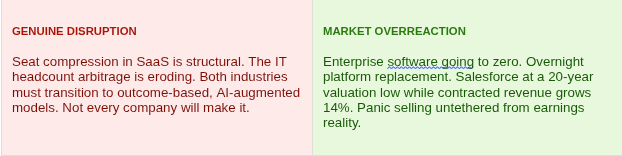
The SaaSpocalypse was not an apocalypse. It was a stress test — one that separated the companies already rewriting their model from those still hoping the cycle turns. Salesforce betting its future on Agentforce, Infosys restructuring around Topaz, TCS piloting smaller AI-augmented teams — these are not defensive moves. They are bets on what enterprise technology looks like in five years.
The disruption is real. The panic is oversized. And the companies that understand the difference between the two are already making their move.

