
CASE STUDY
Optimizing a Mission-Critical NGINX Load Balancing Platform at Scale
Ashnik Team
THE CUSTOMER
A leading credit information services organization operates a large portfolio of business-critical applications serving internal teams, financial institutions and digital services.
THE SOLUTION
Ashnik re-engineered and optimized a critical enterprise load-balancing environment supporting a large application estate, combining configuration rationalization, high-concurrency tuning, application-aware routing, high-availability engineering and security hardening.
THE CHALLENGE
The configuration had evolved organically over time. A conventional migration of the existing configuration would simply have carried the accumulated complexity into the new environment.
THE RESULT
A cleaner, more resilient and more scalable NGINX Plus platform built according to enterprise application-delivery best practices.
600+
Backend server mappings, internal LB configuration
6 nodes
Target production NGINX footprint
4 nodes
DMZ load-balancing tier
Active/Passive
Availability model with Virtual IP
Customer Overview
A leading credit information services organization operates a large portfolio of business-critical applications serving internal teams, financial institutions and digital services.
NGINX formed an important part of the application delivery layer, routing traffic across a large backend ecosystem comprising hundreds of application and service endpoints.
Over several years, this environment had grown significantly. Multiple configurations, legacy routing definitions, application-specific session requirements and different internal and DMZ traffic patterns had accumulated.
The requirement was therefore much broader than refreshing the platform. The customer wanted to optimize a critical load-balancing environment for higher scale, stronger resiliency, improved security, easier operations and more predictable application performance.
The Challenge
The real challenge was to answer a different question: how do we engineer NGINX as a high-performance, resilient and standardized application delivery layer capable of supporting a large backend estate while simplifying operations and improving security?
The Approach
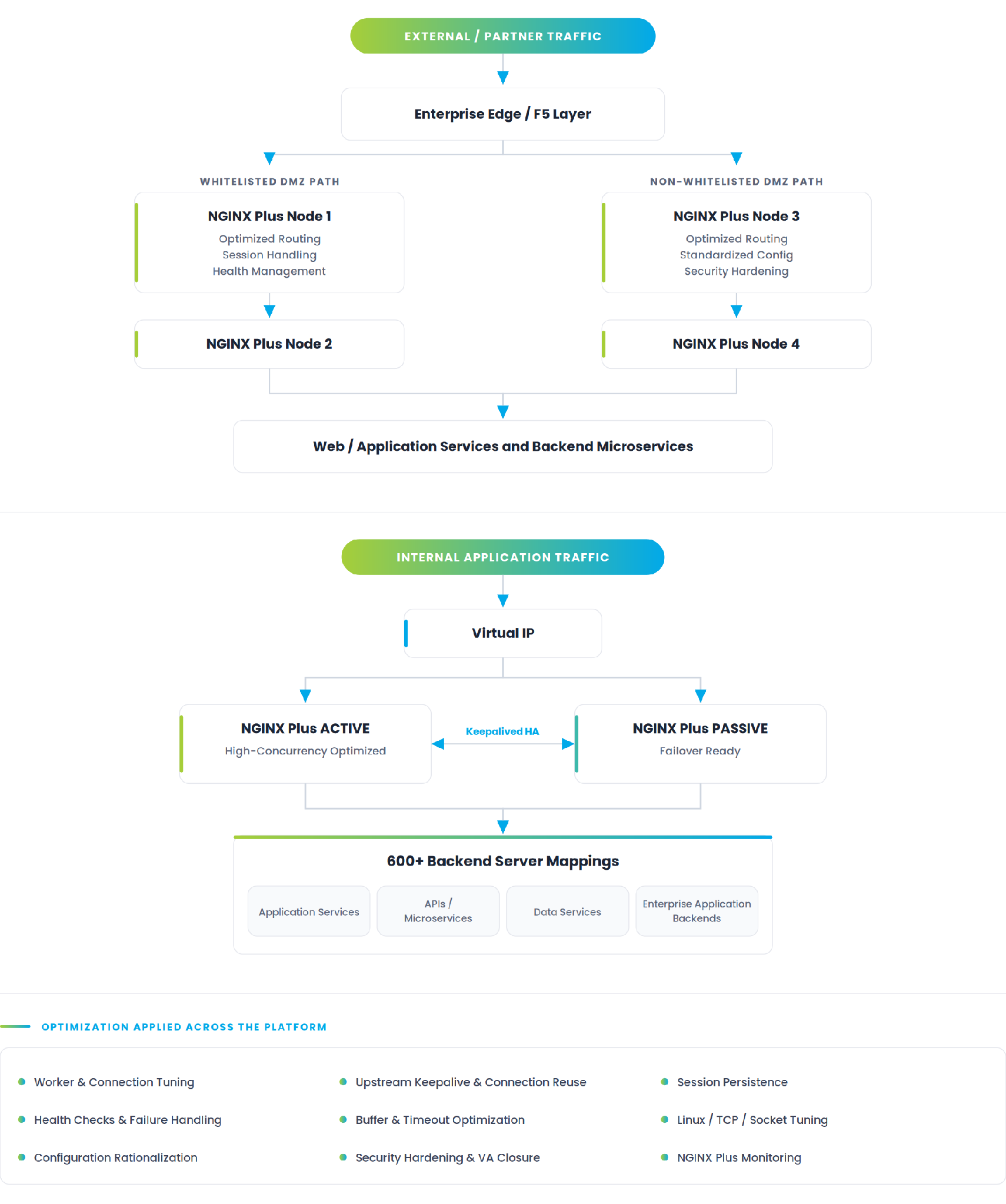
OPTIMIZED ARCHITECTURE
SCALE OF THE PROJECT
This was a large application-delivery optimization exercise rather than a small reverse-proxy deployment. The production architecture covered six NGINX nodes across internal and DMZ traffic paths, and the internal load-balancing configuration handled 600+ backend server mappings covering a broad range of application services and microservice endpoints. Multiple existing configurations also had to be analyzed and reconciled before the final target configuration could be created.
| AREA | SCALE |
|---|---|
| Target production NGINX footprint | 6 nodes |
| Internal HA load-balancing tier | 2 nodes |
| DMZ load-balancing tier | 4 nodes |
| Backend routing estate | 600+ server mappings |
| Legacy DMZ configurations rationalized | Multiple configurations across servers |
| Traffic patterns | Internal, application, web and batch workloads |
| Availability model | Active/Passive with Virtual IP |
| Optimization layers | NGINX, OS, TCP/network, application routing and security |
CONFIGURATION, SECURITY AND OPERATIONAL VISIBILITY
Configuration Best Practices Introduced
Global performance parameters were separated from application-specific routing, upstream definitions were organized and standardized, backend keepalive behavior was explicitly configured and session persistence was applied only where application behavior required it. Timeout and buffer configuration was aligned to workload characteristics, unused backend definitions were removed and logging was structured to provide better visibility into request and upstream behavior.
Security Hardening and VA Closure
Server-version exposure was disabled and communication was restricted to modern TLS protocols. Security-related HTTP headers were incorporated where applicable, access to hidden files and unnecessary paths was restricted and unnecessary information returned through upstream headers was suppressed. The environment was standardized on a current supported NGINX Plus and operating-system platform, and configuration-level observations identified during security and VA reviews were addressed.
Improved Application Behavior
Several applications depended on session persistence and complex backend-routing behavior. Ashnik recreated these application behaviors within the optimized NGINX architecture instead of treating every workload as stateless HTTP traffic, with consistent session routing where required, backend connection reuse, explicitly mapped application routing, standardized failure handling and support for large headers and application-specific request characteristics.
Operational Visibility
The NGINX Plus Dashboard was enabled and validated as part of the environment, giving operations teams greater visibility into NGINX activity and backend behavior. Combined with enhanced logging and system monitoring, the optimized environment provides much stronger diagnostic capability than simply determining whether the NGINX process is running.
RESULTS AND OUTCOMES
| OPTIMIZATION AREA | OUTCOME |
|---|---|
| High-concurrency tuning | Increased connection-handling headroom |
| Linux and TCP tuning | Better foundation for sustained enterprise traffic |
| Backend connection reuse | More efficient NGINX-to-application communication |
| Upstream rationalization | Cleaner and more accurate routing estate |
| 600+ backend mappings | Standardized and validated at scale |
| Session-aware routing | Improved compatibility with stateful applications |
| Health management | More resilient backend traffic distribution |
| Buffer and timeout tuning | Better handling of diverse enterprise workloads |
| Active/passive architecture | Improved availability of the internal LB tier |
| Configuration standardization | Easier troubleshooting and change management |
| NGINX Plus Dashboard | Improved operational visibility |
| Security hardening | Improved security posture and VA closure |
| Modern supported platform | Reduced legacy technology and maintenance risk |
BUSINESS IMPACT
FROM LEGACY LOAD BALANCING TO AN OPTIMIZED APPLICATION DELIVERY PLATFORM
| BEFORE | OPTIMIZED STATE |
|---|---|
| Organically grown configuration | Standardized configuration architecture |
| Large number of historical upstreams | Validated and rationalized backend estate |
| Generic runtime settings | Workload-specific performance tuning |
| Limited connection optimization | High-concurrency connection model |
| Repeated upstream connections | Connection reuse with upstream keepalive |
| Application-specific complexity | Session-aware application routing |
| Basic server availability | High-availability NGINX Plus design |
| Limited health visibility | Backend health management and NGINX Plus monitoring |
| Legacy security settings | Hardened configuration and VA remediation |
| Platform-focused management | Application-delivery-focused operations |