



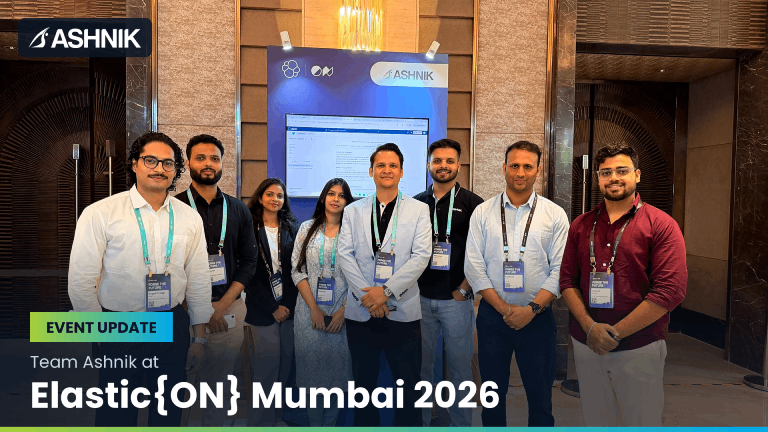

On 30 September, Elastic brought Elastic{ON} to Mumbai for the first time. Ashnik joined as a silver sponsor, and our team spent the day at the booth, in the sessions and in conversation with customers and the wider Elastic community.
One idea ran through the entire day: context. Elastic’s view is that the quality of enterprise AI depends less on which model you choose and more on how well that model can reach your data. Here is a look at what was announced, and what it means for search and observability teams.
Elastic CEO Ash Kulkarni opened by tracing how quickly AI has evolved. It began with natural language processing and question answering. Today, agents carry out tasks, harnesses orchestrate those agents, and agentic systems coordinate work across them.
That progress creates a mismatch. Models, agents and workflows change every few months. The data that matters to a business sits in apps, databases, object stores and telemetry, and it changes on its own terms. Ash described the answer as a context bridge between the two, one that is model-agnostic, accurate, efficient and secure.
Elastic is building that bridge in five layers. A datastore keeps the right data available economically. A semantic index makes information AI-ready. Retrieval finds the right context. Models and agents apply the right intelligence. An action layer turns that context into outcomes.
Underneath it all sits Elasticsearch. Elastic Security and Elastic Observability are built on top, with room for customers to build their own applications. Streams handles ingest, Jina AI provides the models, Kibana visualises and Workflows automates. Within Elasticsearch itself, the building blocks now include a document store, a vector database, columnar mode, hybrid search and ES|QL.
Ash framed this as Elastic 2.0, with Elasticsearch moving from a search engine to the context layer for enterprise AI.
The headline announcement was the Elastic Context Engine. It is designed to give agents complete context that does not go stale, improve accuracy over time, use fewer tokens on every turn, and work with any agent harness.
It addresses a problem many enterprise AI teams run into. When a model receives outdated, incomplete or excessive context, answers become unreliable and costs climb. The Context Engine works alongside Elasticsearch, Streams, Jina AI, Kibana and Workflows so that agents see the right information at the right time.
For teams already running Elastic for search and observability, this is a direct shift. The platform that stores your logs and documents now also decides what your AI can see.
Most observability teams today are not short of data. They are short of time. Alerts pile up, logs grow faster than anyone can read them, and the root cause often surfaces hours after the incident. Elastic’s observability launches were aimed squarely at that gap, with AI doing more of the investigation and the data platform doing more of the heavy lifting:
Search is where the context bridge starts. If the right document, record or log line cannot be found, no model can use it. Elastic’s search launches focused on two things: making retrieval easier to set up, and bringing more of an enterprise’s data within reach:
An AI application can only answer from what it can retrieve. For BFSI, where much of the knowledge still sits in documents and scanned records, this opens up data that was hard to use before.
AlertZero is the agentic layer of Elastic Security. Five agents cover every alert, rule and hunt, with a human on the loop.
With nightshift on the observability side, the pattern is clear. Agents handle the round-the-clock work. People make the decisions.
Our conversations at the booth were built around four themes, each closely aligned with where Elastic is taking its platform.
Our live demo followed a single operations scenario from raw data to root cause. We started with Streams, onboarding logs from any source without manual configuration. We then used Elastic Agent to work through that data and surface the root cause, so the team could move from chasing alerts to fixing the actual problem.
Almost every team that stopped by recognised the challenge. There is too much log noise, and it takes too long to get to the why.
If you missed it, we cover the same story in depth in our on-demand webinar with Elastic, From Raw Data to Resolved Incidents for BFSI. Over 60 minutes, experts from Elastic and Ashnik show how AI Streams speeds up log onboarding, how Attack Discovery turns thousands of raw alerts into clear attack narratives, and how a live incident moves from raw data to resolution. Watch it on demand.
Across the keynote, the launches and the conversations at our booth, the message was consistent. AI in the enterprise depends on the foundation underneath it: well-managed data, reliable retrieval and strong observability. Models will keep changing. The organisations that get their context right now will be able to adopt each new model faster.
At Ashnik, we approach AI readiness through three pillars: Data, Access and Observability. Our Observability & Search Platform, built with Elastic, helps enterprises assess, architect, implement, modernise, optimise and operate that foundation, the Open Source way.
Thank you to Elastic for a great first edition in Mumbai, and to everyone who visited our booth. To continue the conversation, write to us at success@ashnik.com.