


The renewal quote arrives. It is higher than last year. Someone asks: why not switch?
The answer is rarely the licence. It is the code. Hundreds of services carry one vendor’s agent. Leaving means re-instrumenting the estate and running two stacks while you do it. So the contract gets renewed.
Now take the hardest version of the same problem. A regulated enterprise runs two OpenShift clusters and 250+ virtual machines. The network is air-gapped. Application images cannot be changed. No data can leave. Here, the vendor model does not just lock you in. It locks you out. The standard way to add an agent is to rebuild the image, and that is not allowed.
Both stories have the same root. The vendor owned the instrumentation. OpenTelemetry moved that ownership back to the enterprise. This article shows what that changes, and returns to that air-gapped estate at the end.
For years, observability came as a bundle. The vendor’s agent, data format and backend were fused. Your data, their schema.
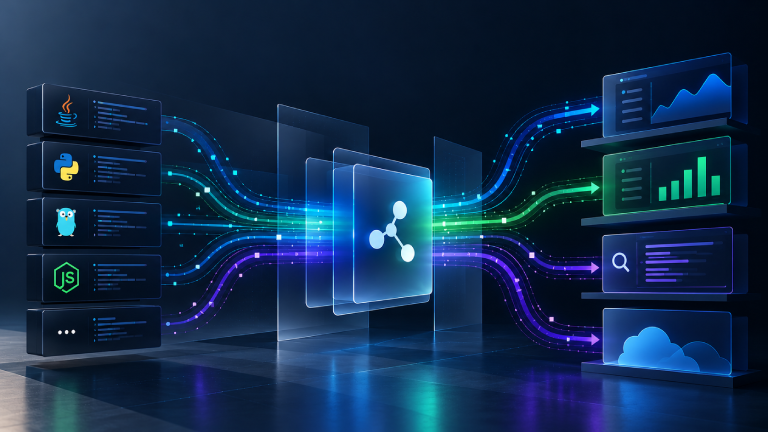
OpenTelemetry separated those layers. Instrumentation is written once, against open SDKs. Data travels over one open protocol, OTLP. The OpenTelemetry Collector, run by the enterprise, shapes and routes it. Any OTLP-compatible backend can receive it. Instrumentation itself becomes something the enterprise controls. It can even be injected at pod startup, with no change to the application image.
In May 2026, the CNCF moved OpenTelemetry to graduated status, its highest maturity level (CNCF announcement). For enterprise buyers, that settles whether it is here to stay.
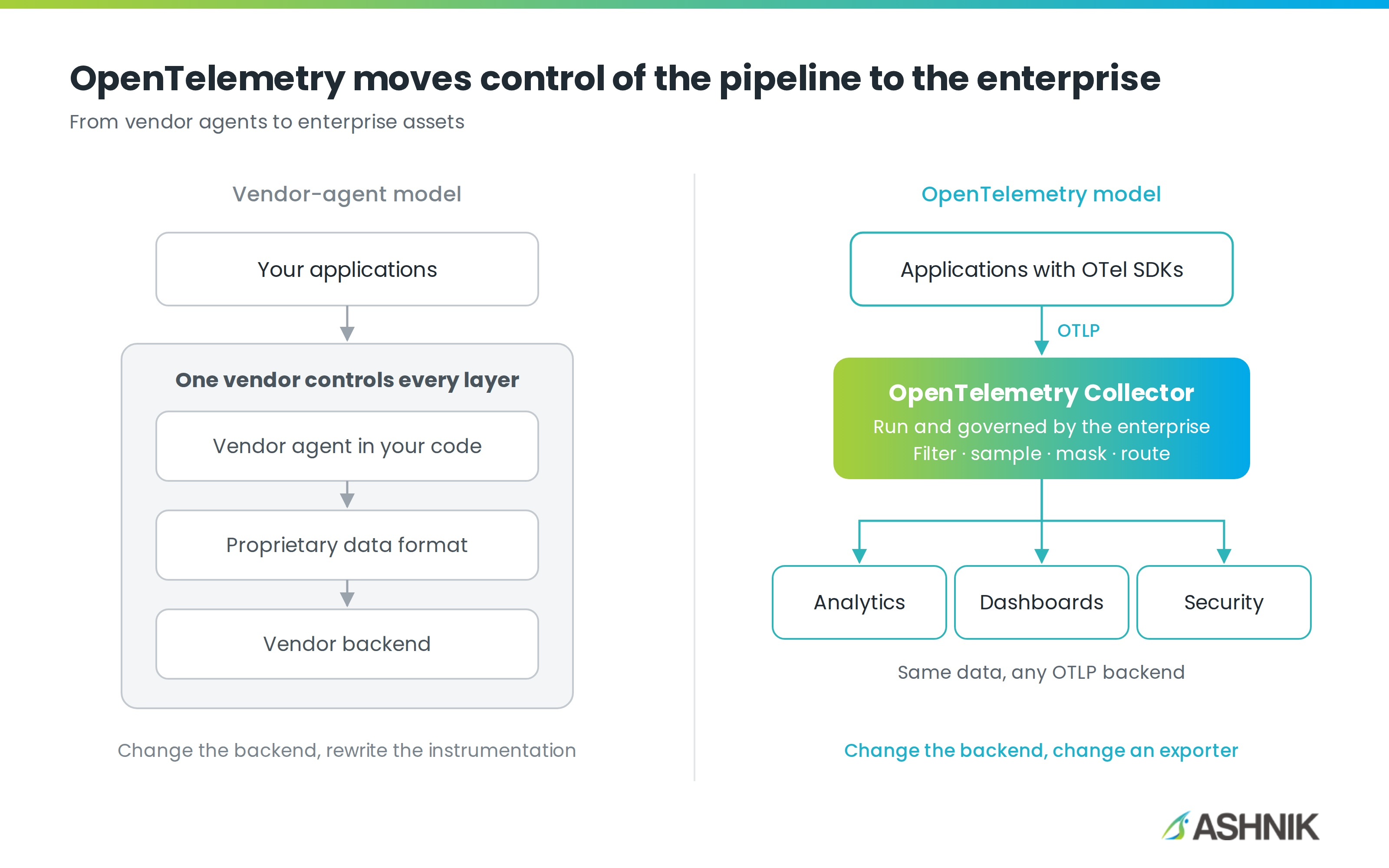
On the left, every layer belongs to one vendor. On the right, the enterprise owns the instrumentation and the pipeline, and backends become interchangeable.
Every row moves a decision from the vendor to the enterprise.
LLM apps and agents chain model calls, retrievals and tool calls. Without tracing, a slow or wrong answer is a black box. OpenTelemetry’s GenAI semantic conventions, covering agents and MCP, address this. They are still in development, so expect field names to change.
The reverse holds too. AI-assisted analysis is only as good as the telemetry beneath it. Open, correlated data is part of the foundation for running AI in production.
Freedom comes with responsibility. Control has to be exercised.
Return to the enterprise from the opening. Its question was never which backend to buy. It was whether it could instrument its own estate, on its own terms. One more constraint made it harder: cluster-admin rights for the standard OTel Operator webhook were not available. Ashnik’s design used OpenTelemetry to work within every one of them.
The result was request-level tracing across the Java estate where none existed, with zero image changes. Every layer, from instrumentation to pipeline, stayed under the enterprise’s control. Logs and metrics used OpenShift’s Cluster Log Forwarder and Metricbeat. Hybrid, by choice (full walkthrough).
This is how Ashnik approaches OpenTelemetry: as part of an Observability & Search Platform, built through Assess → Architect → Implement → Modernize → Optimize → Operate, with right-fit technologies such as Elastic, Grafana, Netdata and Cardinal.
The shift from vendor agents to enterprise assets is not a product upgrade. It is a decision to take control back.
Talk to Ashnik about assessing your observability estate.