
CASE STUDY
Ashnik Delivers Automated Application Delivery with F5 CIS, IPAM and NGINX for a Leading Telecom Provider
Ashnik
Customer identity is not disclosed in this case study. Details reflect a solution engagement delivered for a telecommunications sector customer.
THE CUSTOMER
A leading telecommunications service provider running enterprise application platforms that increasingly rely on Kubernetes.
THE SOLUTION
A controller-driven integration — F5 CIS and F5 IPAM automating BIG-IP configuration and VIP allocation for both NGINX Ingress Controller and NGINX Gateway Fabric.
THE CHALLENGE
Kubernetes moved fast; network provisioning was ticket-driven and manual, requiring cross-team coordination for every VIP and routing change.
THE RESULT
Automated VIP allocation through IPAM, static and dynamic publishing validated side by side, central BIG-IP governance retained throughout.
0
Manual BIG-IP tickets required for standard onboarding
100%
BIG-IP governance retained by the network team
2 in 1
Routing models — Ingress and Gateway API — governed through a single BIG-IP layer
4
Governance controls enforced throughout automation
Customer Overview
The customer’s application platforms increasingly run on Kubernetes, while F5 BIG-IP has long served as the organization’s established external load-balancing and application-delivery layer. Kubernetes workloads change on a materially faster cycle than traditional network infrastructure.
The organization required its application platforms to remain reliable, scalable, and centrally governed — without requiring network teams to manage every new service through a fully manual process. Ashnik was engaged to design, deploy, and validate that balance in practice, keeping BIG-IP as the enterprise entry point while Kubernetes teams gained the automation their release cycle demanded.
The Challenge
Kubernetes moves fast. Network processes often don’t.
Solution Overview
A controller-driven bridge between BIG-IP and Kubernetes. Kubernetes resources drive BIG-IP configuration automatically, with BIG-IP retained as the enterprise entry point for application traffic.
Static and Dynamic VIP Allocation
Two allocation models, both implemented and validated end to end. The choice depends on application criticality, whether an address is already reserved, and expected onboarding volume.
Both approaches were implemented and validated end to end. The two models are not mutually exclusive — reserved addresses remain available for critical or externally governed applications, while standard workloads draw addresses automatically from controlled IPAM pools.
The Approach
Executed in controlled, independently tested stages. Each integration point was validated on its own before the complete traffic path was tested end to end.
Architecture
Two validated paths, one BIG-IP and IPAM automation layer.
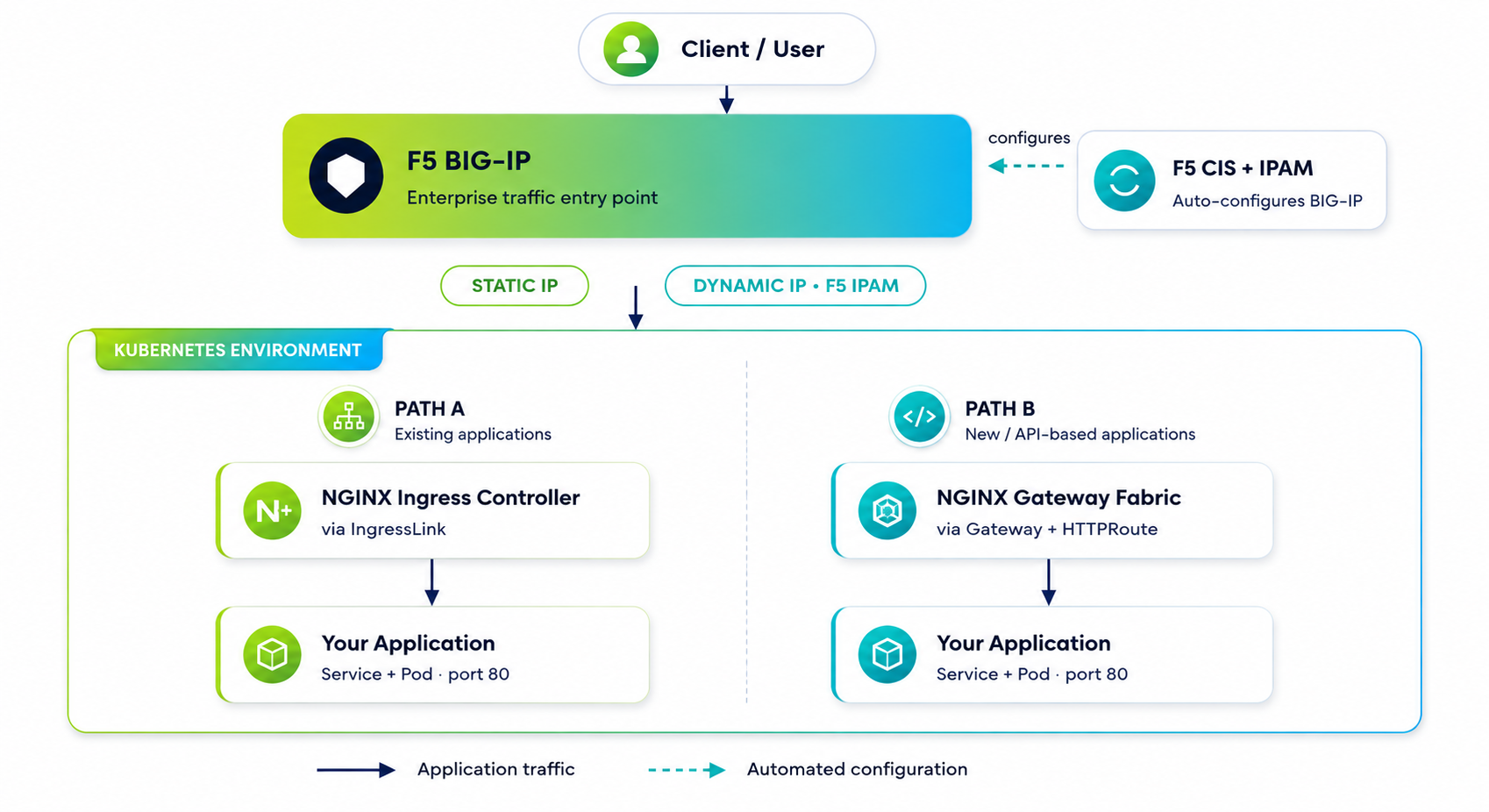
A client reaches the application through an external VIP on F5 BIG-IP, using either a static IP or a dynamic IP allocated by F5 IPAM. F5 CIS and F5 IPAM automatically configure BIG-IP in response to Kubernetes activity. Inside the Kubernetes environment, traffic reaches the application through NGINX Ingress Controller for existing applications, or NGINX Gateway Fabric for new, API-based applications — both landing on the application Service and Pod on port 80.
Technical Validation
This phase focused on the core integration and end-to-end traffic flow. High-availability sizing, performance benchmarking, WAF policy design, and multi-cluster scaling are scoped for the customer’s next phase of rollout.
| VALIDATION AREA | RESULT |
|---|---|
| F5 CIS connectivity to BIG-IP | Successful |
| F5 IPAM dynamic VIP allocation | Successful |
| Static VIP publishing | Successful |
| NGINX Ingress Controller via IngressLink | Successful |
| NGINX Gateway Fabric via Gateway API | Successful |
| Backend connectivity to Kubernetes Pod | Successful |
| End-to-end application access | Successful |
| COMPONENT | VERSION |
|---|---|
| F5 BIG-IP | 17.5.1.1 |
| F5 Container Ingress Services (CIS) | 2.20.4 |
| F5 IPAM Controller | 0.1.13 |
| NGINX Ingress Controller | 5.5.4 |
| NGINX Gateway Fabric | 2.6.7 |
| Kubernetes | 1.33.7 (upstream) |
Outcome
Business Benefits
Translating the technical outcomes into business value.
Engagement Deep-Dive
Technical notes for engineering and audit review, one level deeper than the summary above. These notes maintain the same anonymized, factual approach as the rest of this document — no customer name, internal system names, IP ranges, or cluster and namespace details.