


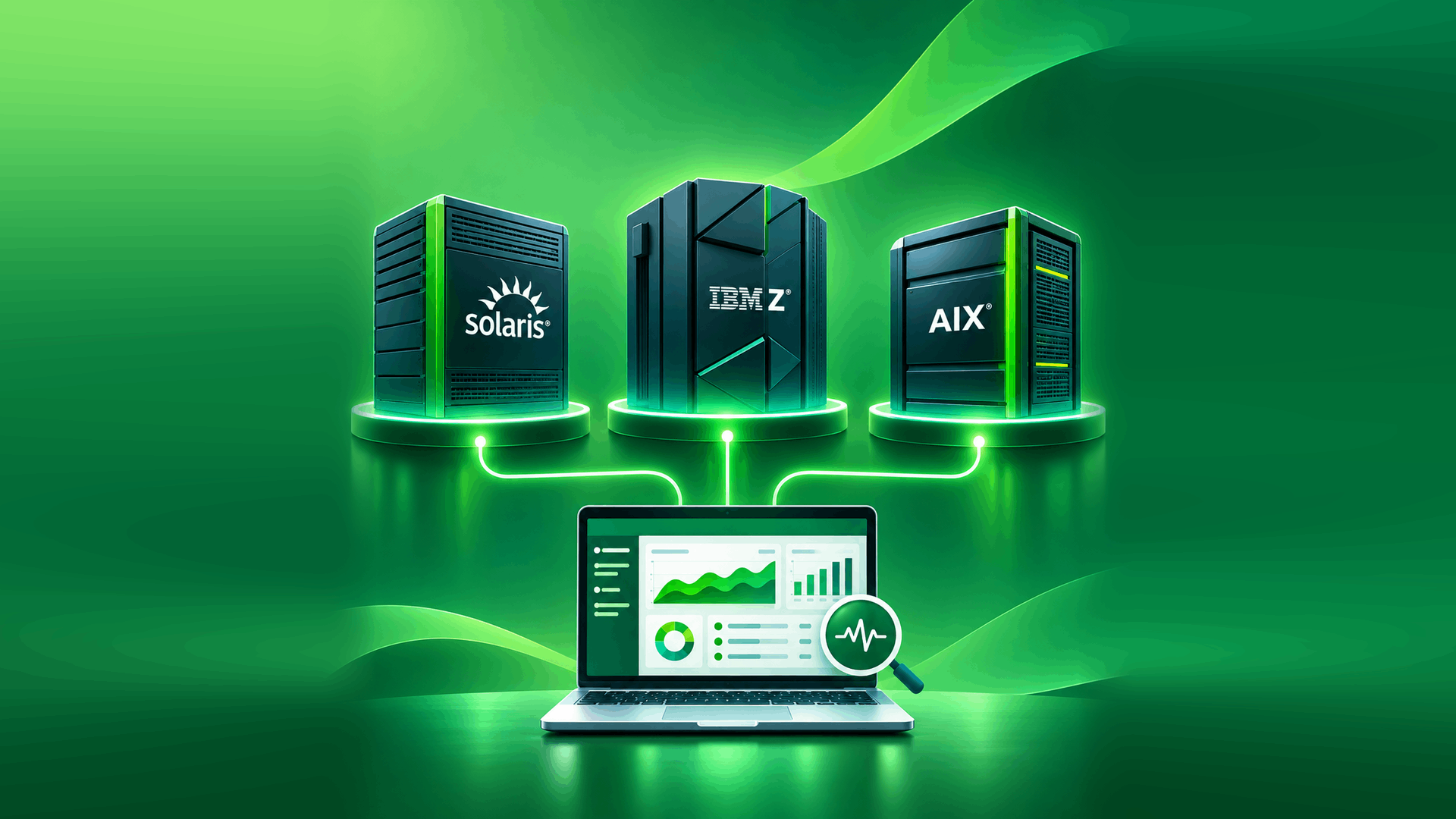

Most observability rollouts start with Linux on x86, and that part usually goes smoothly. The harder question comes later, when the team reaches the systems that actually run the business: Oracle Solaris, IBM AIX and IBM Z.
These platforms are still common in banking and regulated industries, and for good reason. They are stable, certified and costly to move away from. But the collection agents that modern Observability platforms rely on were not built with them in mind, and most are not supported on them.
Ashnik has worked through this problem with three organisations in financial services, each on a different platform. None of them wanted to replace systems that worked. Here is where each one started.
A leading small finance bank runs its banking services on Oracle Solaris 11.4, with WebLogic and SOA in the middle tier and Oracle Database 19c underneath. The bank wanted a single operational view from the application down to the database.
The obstacle was easy to state and hard to solve. There was no supported Elastic Agent or Beats pattern for Solaris, and the bank would not put unsupported software on a business-critical estate.
Read the full story: Unified Observability across Solaris, WebLogic and Oracle →
At a financial regulator, the trouble surfaced during a nationwide quiz. Two mission-critical applications, used by officials across the country, came under heavy concurrent load, and the knowledge portal stopped responding. The incident was escalated to senior management.
The team could not say which tier had failed. Part of the application and database stack ran on IBM Z, where application performance monitoring had never been validated in that environment.
Read the full story: From POC to production in 20 days →
The third case began with a centralised Observability rollout on Elasticsearch and Kibana at a BFSI organisation. The Linux servers were sending data within hours.
Progress stopped at the IBM AIX servers, which ran WebSphere, MQ and DB2 and were among the most critical systems in the environment. As at the bank, there was no supported agent for the platform. The network was also air-gapped, and several firewall ports were blocked.
Read the full story: How we brought IBM AIX into the Observability platform →
The three platforms stalled for different reasons: a missing agent on Solaris, an unvalidated tier on IBM Z, a blocked rollout on AIX. The answer followed the same pattern each time. Ashnik left the core systems as they were and brought their telemetry into one Observability platform, using open-source tooling suited to each platform.
If your estate still includes Solaris, AIX, or IBM Z, talk to Ashnik’s Observability team →