



RKE2, short for Rancher Kubernetes Engine 2, is SUSE’s enterprise-ready, security-hardened Kubernetes distribution, built for workloads that cannot afford to get infrastructure wrong.
Every Kubernetes distribution makes a trade-off. Most optimize for developer convenience or edge footprint. RKE2 optimizes for something else entirely: passing an audit without a fight. That is not a secondary feature; it is the reason the distribution exists, and it is why RKE2 is the standard answer when a workload cannot tolerate an unpatched CVE, an unreviewed control, or a control plane with no clear line of accountability.
For any infrastructure team still running RKE1, that answer just became mandatory. RKE1 reached end of life on July 31, 2025. There is no in-place upgrade path. SUSE’s own guidance is direct: replatform to RKE2 or K3s. This is not a roadmap discussion anymore; it is an active migration decision with a deadline already behind it.
What follows is a technical account of what RKE2 is and why it holds the position it does in enterprise Kubernetes strategy, drawn directly from SUSE’s architecture and security documentation, not from marketing copy.
RKE2, officially SUSE Rancher Prime: RKE2, is Rancher’s enterprise-ready, next-generation Kubernetes distribution. It was built under the name RKE Government for a reason: the U.S. federal government does not accept a “good enough” security posture, and RKE2 was engineered from day one to clear that bar. That is the same bar BFSI, healthcare, and other regulated sectors operate under, which is exactly why RKE2 keeps surfacing in those conversations.
The distribution is fully CNCF-conformant. Every kubectl command and YAML manifest your team already knows works against RKE2 exactly as it would against any other conformant cluster. There is no dialect to learn and no proprietary API surface to reason about. SUSE built RKE2 by taking two lineages and keeping only their strengths: from K3s, operational simplicity; from RKE1, tight alignment with upstream Kubernetes, in the places where K3s deliberately diverged to optimize for the edge. The result installs in minutes and behaves exactly like the Kubernetes your team already knows how to run.
One decision separates RKE2 from its predecessor outright: it does not run on Docker. RKE1 depended on Docker for both the control plane and the container runtime, which meant patching and securing Docker itself as a standing liability. RKE2 removes that dependency entirely. Control plane components run as static pods under kubelet, with containerd as the embedded runtime, the same direction upstream Kubernetes itself took when it deprecated dockershim. Fewer moving parts mean a smaller attack surface and less to patch
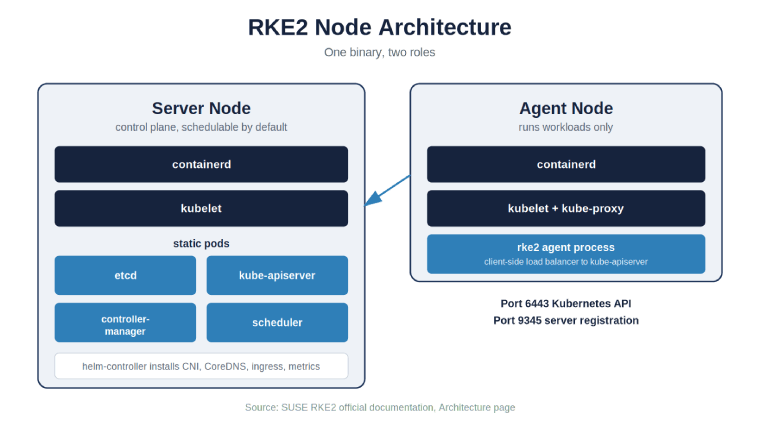
RKE2 ships as a single binary, and that single binary is the entire installation. Point it at a node and it bootstraps exactly the components that node needs, server or agent, pulling everything from a runtime image that bundles containerd, kubelet, runc, and the container shims. There is no manual assembly of a dozen separate binaries and no version-matching exercise across components.
On a server node, RKE2 writes static pod definitions for etcd, kube-apiserver, kube-controller-manager, and kube-scheduler directly to disk, and kubelet takes it from there, starting each one in the order it needs: etcd first, kube-apiserver once etcd answers, then the controller manager and scheduler once the API server is live. The moment the API server is ready, an embedded Helm controller inherited from K3s takes over and installs the CNI (Canal, Cilium, Calico, or Flannel), CoreDNS, ingress (Ingress NGINX and/or Traefik), and Metrics Server, without an operator touching Helm directly.
This matters more than it might look at first glance. There is no separate etcd cluster to provision and secure on its own timeline; it ships embedded and is governed by the same lifecycle as everything else. And because the control plane runs as ordinary static pods, it recovers from a crash exactly the way any workload pod does, under kubelet supervision, with no bespoke command line
The single-binary claim is easy to state and easy to verify. Standing up a server node is the official install script followed by two systemd commands:
curl -sfL https://get.rke2.io | sh -

systemctl enable rke2-server.service

systemctl start rke2-server.service
Joining an agent node is the same install script with one environment variable, pointed at a config file with two lines:
curl -sfL https://get.rke2.io | INSTALL_RKE2_TYPE="agent" sh -# /etc/rancher/rke2/config.yaml
server: https://:9345
token:
And the CIS hardening posture referenced earlier is not a separate hardening project; it is one line in that same config file:
# /etc/rancher/rke2/config.yaml

profile: "cis"
That single profile flag is what triggers the CIS-aligned defaults covered below: restrictive file permissions on manifests, the etcd process running as a dedicated non-root user, network policies applied automatically, and Pod Security Admission enforced in restricted mode across every namespace except the system ones that require privileged access to function.
This is the argument that actually moves a platform decision inside a regulated enterprise. RKE2 ships with defaults that pass the CIS Kubernetes Benchmark, currently validated against v1.9 and v1.10, with minimal operator intervention, not after weeks of manual hardening. It enables FIPS 140-3 compliance by statically linking every component except Traefik with Go+BoringCrypto, the cryptographic module FIPS enablement actually depends on. SUSE scans every component for CVEs with Trivy as a standing part of its build pipeline, so vulnerability data exists before an auditor ever asks for it, not after.
Put that in hours. A platform team hardening vanilla Kubernetes to pass a CIS benchmark from scratch is looking at weeks of configuration, testing, and re-testing, and still carries the risk of missing something an auditor catches instead. RKE2 collapses that into a documented profile flag. That is not a convenience, it is a direct reduction in the cost and risk of every compliance cycle a regulated workload has to pass.
An RKE2 production cluster does not need a separate HA strategy bolted on top. Three things make it highly available by design: a fixed registration address in front of the server nodes, an odd number of server nodes, three is the documented minimum, running etcd and the control plane, and any number of agent nodes underneath. The odd-node requirement is not a stylistic preference, it is etcd quorum math: quorum is (n/2)+1, so three server nodes gives a quorum of two, meaning the cluster survives losing one node without losing the ability to read or write cluster state. Agents reach the API on port 6443 through a load balancer built directly into the agent process itself, and port 9345 handles registration. There is no external load-balancing layer to stand up on the agent side.
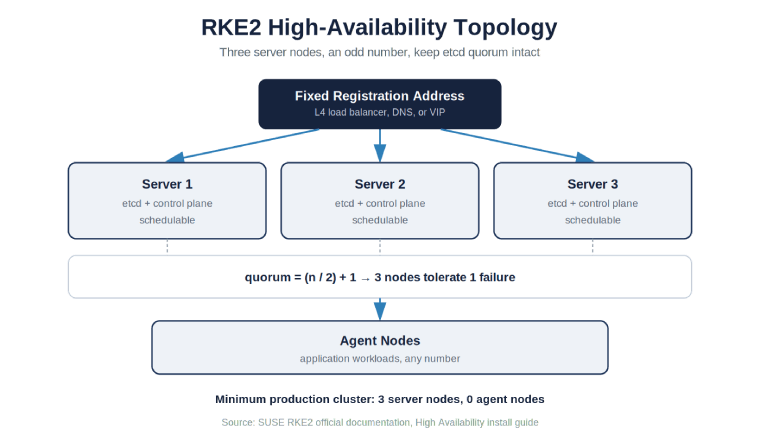
Put a number on that for capacity planning: three server nodes and zero additional agent nodes is a complete, fault-tolerant production control plane, because server nodes are schedulable by default. That is a concrete answer for a budget conversation, not an estimate.
RKE2 runs standalone or fully integrated into Rancher Prime, and Rancher has provisioned RKE2 clusters automatically since v2.6. That sequencing matters. A platform team can stand up a single RKE2 cluster for one regulated workload, prove the model, and bring it under centralized Rancher governance, RBAC, monitoring, GitOps through Fleet, later, without re-platforming the cluster itself to get there. The architecture decision made today does not become the constraint that blocks tomorrow’s scale-up.
RKE1 reached end of life on July 31, 2025. SUSE’s own guidance leaves no ambiguity: existing RKE1 customers should replatform to RKE2 or K3s; there is no in-place upgrade. Any team still operating RKE1 in production is already past the point where this is a planning exercise.
RKE2 owns one job inside SUSE’s Kubernetes platform: the data center and regulated production layer. K3s takes the equivalent role at the edge, where footprint matters more than benchmark compliance. Rancher Prime manages both centrally, and Fleet drives GitOps across however many clusters a platform team ends up running. None of that changes what RKE2 is on its own: a CNCF-conformant, security-hardened distribution built to be the default choice for any workload that has to answer to an auditor.
If your infrastructure team is weighing a replatform off RKE1, or evaluating a Kubernetes distribution for a new regulated workload, talk to the Ashnik team. We will walk through what actually fits your compliance and infrastructure requirements.