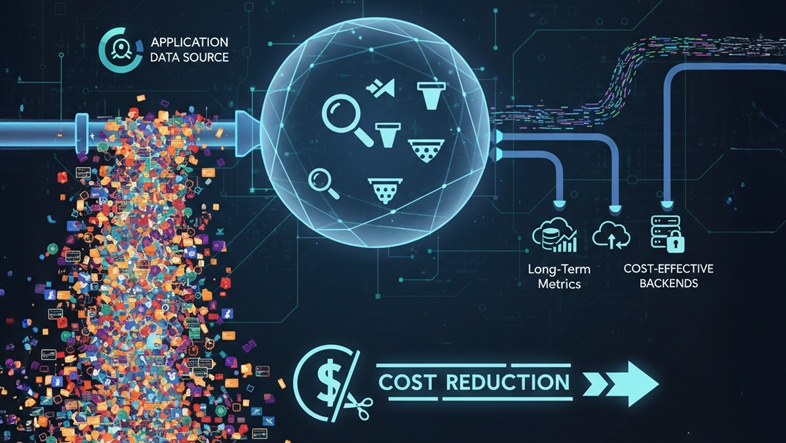



For years, observability ingestion has been dominated by vendor-specific agents, collectors, and tightly coupled pipelines. Each monitoring platform came with its own way of collecting data, its own agent, and its own opinionated ingestion path. While this worked in isolated setups, it created a long-term problem: vendor lock-in, operational rigidity, and limited freedom of choice.
OpenTelemetry (OTEL) Collectors are quietly but fundamentally changing this model.
This article explores how OTEL Collectors function as the new ingestion control plane, emphasizing the decoupling of collection, storage, and analytics, and explaining the critical architectural difference between the OTEL SDK, Collector Agent, and Collector Gateway.
This approach worked reasonably well when applications were monolithic, infrastructure was static, and the technology stacks were uniform.
At this inflection point, a fundamental problem became visible: Instrumentation, collection, storage, and analytics were tightly coupled, and that coupling became the bottleneck. Every change, whether a vendor migration or a data cost optimization, required coordinating with the vendor’s proprietary agent, pricing model, and ingestion limits. OpenTelemetry emerged not to replace observability tools, but to decouple these layers, enabling systems to scale without locking architectural decisions too early.
One of the biggest challenges with OpenTelemetry adoption is trying to map it directly onto the existing “agent + backend” thinking. That mapping is incorrect.
OpenTelemetry introduces a layered architecture where each component has a specific, isolated responsibility.
| Component | Runs | Core Responsibility |
|---|---|---|
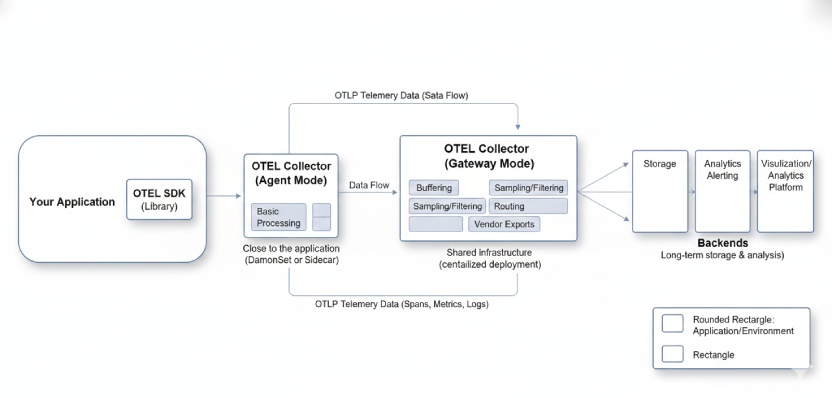
| OTEL SDK | Inside the application (library) | Produces telemetry data such as spans, metrics, and logs in OTLP format |
| OTEL Collector (Agent Mode) | Close to the application (DaemonSet or Sidecar) | Provides local reliability through buffering, basic processing, and transport to the Gateway |
| OTEL Collector (Gateway Mode) | Shared infrastructure (centralized deployment) | Enforces global policies, performs advanced processing like sampling and filtering, handles routing, and manages vendor exports |
| Backends | External storage and analytics systems | Handles long-term storage, visualization, alerting, and analytical workloads |

The OpenTelemetry SDK is often misunderstood as “just another agent.” In practice, its role is strictly limited to observation.
Inside an application (e.g., Python, Java, Go, Node.js), the SDK:
The architectural clarity is here:
The SDK’s role is to observe the application, not to make infrastructure decisions. It merely hands off the data to the Collector.
The Collector is the single most critical component for decoupling. It is a vendor-neutral, standalone telemetry pipeline that sits between your applications and your observability backends.
The power of the Collector is rooted in its three core functions: Receivers, Processors, and Exporters.
To achieve scalability and resilience, the Collector is deployed in two different modes:
| Mode | Role | Deployment Model | Benefit |
|---|---|---|---|
| Agent | Local reliability | Sidecar (per service) or DaemonSet (per host) | Minimizes network hops, provides immediate buffering, and offloads processing from the application |
| Gateway | Central governance | Dedicated deployment such as a Kubernetes Deployment | Centralizes policies like sampling, cost management, and routing, and handles vendor exports and retries |
This separation of concerns—proximity (Agent) versus policy (Gateway)—is vital for operating a resilient, distributed observability platform.
Let’s move away from theory.
Requirement: End-to-end request tracing, database visibility, no vendor lock-in, and the future ability to send data to multiple tools.
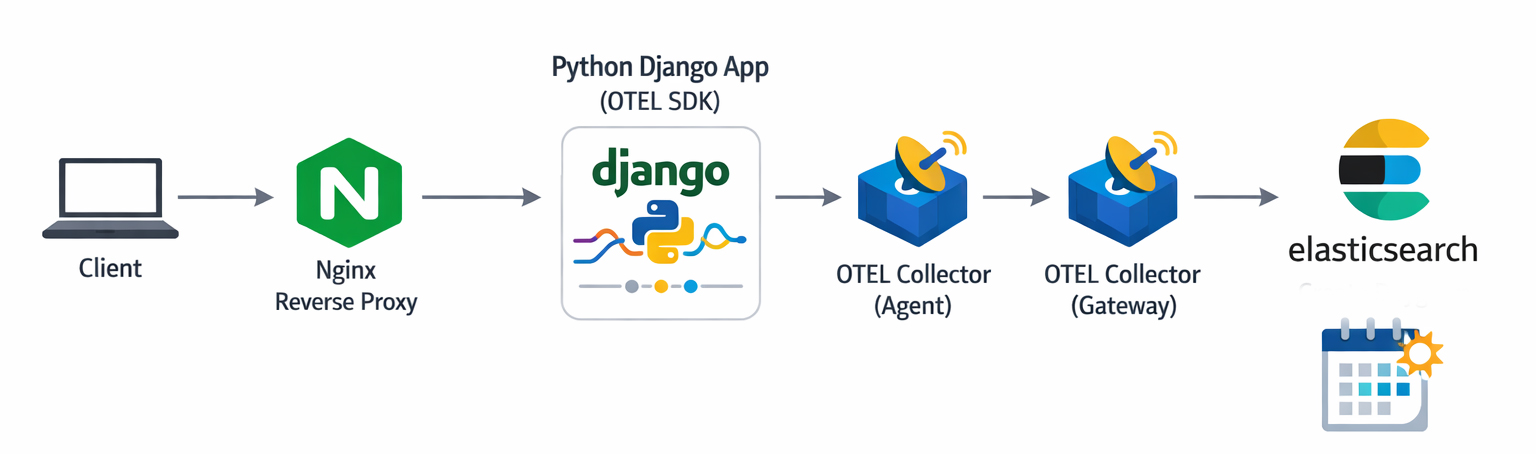
At no point is the application aware of the Backend type, Storage format, or Analytics tool. This decoupling of Collection, Storage, and Analytics is the biggest benefit of the OTEL Collector architecture.
This article intentionally focuses on architectural intent rather than deployment mechanics. OpenTelemetry Collectors mark a shift in how observability ingestion is designed, separating application instrumentation from backend and vendor decisions. In our work with enterprises at Ashnik, this decoupled model has become essential for building scalable, governable observability platforms that can evolve with modern production systems without repeated reinstrumentation or lock-in.