



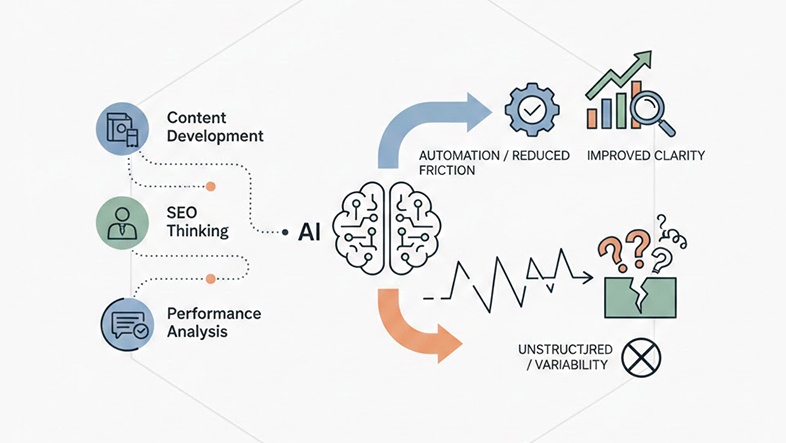

Over the past year, AI has become part of how I approach everyday marketing work. It shows up across content development, SEO thinking, performance analysis, and parts of execution that benefit from automation. This did not happen in a single shift. It evolved gradually as AI tools became reliable enough to support real workflows rather than isolated experiments.
What became clear over time is that AI’s value in marketing has less to do with how much it can automate and more to do with where it is placed within the system. Used well, it reduces friction and improves clarity. Used without structure, it introduces variability that is difficult to manage at scale.
Most marketing inefficiencies are not caused by a lack of ideas or tools. They stem from the effort required to interpret inputs before decisions can be made.
This shows up in areas like:
AI reduced the cost of interpretation. Drafting content became faster. SEO signals were easier to reason about. Performance trends surfaced earlier. What it did not solve on its own was execution.
As AI became more capable, it was tempting to let it influence prioritisation and execution decisions more directly. The assumption was that faster analysis should naturally lead to faster action.
In practice, this created instability.
Marketing decisions rarely exist in isolation. Activities such as publishing content, adjusting SEO direction, or changing campaign behaviour operate within constraints that are often implicit rather than documented.
These include:
When AI-driven decisions bypassed these constraints, the efficiency gained upfront was often lost in correction later. The system became faster, but less predictable.
The shift that made AI consistently useful was treating it as an intelligence layer rather than a decision-maker.
AI proved most effective when used to:
Execution, however, remained governed by explicit rules and conditions. Once that separation was clear, AI stopped feeling experimental and started feeling dependable.
The most important change was not selecting better tools, but defining clearer boundaries around how AI outputs were used.
AI-generated insights were always treated as inputs into a system with defined conditions for action:
These boundaries applied consistently across content publishing, SEO decisions, and performance adjustments. They reduced ambiguity and made outcomes easier to anticipate and explain.
One mental model has held up across different types of marketing work.
Interpretation benefits from flexibility. Execution benefits from clarity. Keeping those roles distinct allows both to improve without destabilising the system.
Automation is often equated with autonomy. In marketing, that equivalence is misleading.
Most marketing actions are:
When something goes wrong, understanding why it happened matters as much as correcting it. Systems that act without clear constraints make that harder, not easier. In practice, attempts to push toward full autonomy almost always lead to the reintroduction of guardrails.
With AI positioned correctly, marketing work became more efficient in ways that held up over time.
Judgement did not disappear. It was simply applied where it mattered most.
AI has materially improved the efficiency of marketing work, but not by replacing decision-making. Its real contribution has been in improving understanding while leaving execution grounded in explicit constraints.
When AI is used to inform, and deterministic boundaries govern action, marketing systems become faster without becoming fragile. That balance is what allows AI to be useful beyond early experimentation and sustainable in real production environments.
The question is not how much marketing can be automated. It is how thoughtfully automation is designed.